Most health-conscious people have heard of magnesium (Mg), but many of them don’t know a whole lot about it. Compared to other vitamins and minerals, it tends to fly under the radar. But, it’s a vital nutrient that’s essential for good health.
You may remember magnesium from the periodic table of scientific elements that was posted in your middle school science classroom. It plays a critical role in metabolism, and the body uses it for more than 300 biochemical reactions. Those processes support your immune system, promote a healthy nervous system and brain, maintain cardiovascular health, and build strong muscles and bones.
So, it’s no surprise that when you do not get enough of this macromineral, your health can be negatively affected.[1]
What Is Magnesium Deficiency?
The human body doesn’t produce magnesium; you have to get it through your diet. Magnesium deficiency occurs when you don’t get enough magnesium in your diet or can’t use the magnesium you do consume.
Normal magnesium levels fall between 0.75 and 0.95 mmol/L. Hypomagnesemia, which is an excessive magnesium deficiency, is a blood serum level below 0.75 mmol/L.[2]
While fewer than 2 percent of Americans have reached a clinically deficient state of magnesium, up to 75 percent of Americans don’t meet the daily recommended intake.
Even though you may not feel the immediate effects of low magnesium, it can have short- and long-term implications for your health.[3]
What Causes Magnesium Deficiency?
Ultimately, not getting enough magnesium or not using what you do get is what causes magnesium deficiency. Sometimes, even when you get the recommended daily allowance (RDA) of magnesium in your diet, your body is unable to use it. This can happen if the magnesium you consume is not well absorbed by your body — in other words, it has low bioavailability. There are different types of magnesium with varying levels of bioavailability. Additionally, certain conditions can also reduce the bioavailability of the magnesium you consume.
These include:[4]
Kidney disease and ailments, including kidney stones
Type 2 diabetes
Certain types of chemotherapy
Alcohol dependency
Advanced age
What Are the Signs of Magnesium Deficiency?
There are a variety of magnesium deficiency causes and symptoms, though many people who aren’t getting enough magnesium are asymptomatic.
Symptoms of magnesium deficiency include:
When your levels of magnesium are low, you may experience other health issues. Below are some of the conditions and symptoms that commonly occur with low magnesium.
Hormone Imbalances
Magnesium keeps certain hormones balanced and under control. Specifically, magnesium helps the thyroid convert the hormone T4 into its usable form, T3, which affects metabolism. It also helps regulate cortisol — aka the stress hormone. When magnesium levels are low and these hormones become unbalanced, your insulin resistance may increase, you may gain weight, have skin problems, or struggle with anxiety or depression.[5]
Anxiety
Scientists have linked mental health conditions and neurological disorders that affect mood and memory to low magnesium levels. New research indicates that magnesium also protects the brain and nerve cells, preventing neurons from firing excessively, which scientists have linked to anxiety.[6]
High Blood Pressure
Scientists have linked lower magnesium levels to hypertension (high blood pressure). Increasing your intake of magnesium and potassium can help promote normal blood pressure — and can even make other blood pressure-lowering strategies more effective.[7]
Sleep Issues
Low magnesium levels also affect sleep and interfere with the body’s ability to produce sleep-enhancing hormones. When this happens, it can cause issues such as restless leg syndrome, sleep apnea, or insomnia.[8] Magnesium also calms your nervous system, which helps you go to sleep in the first place.
Asthma
Studies show that people with asthma often have low magnesium levels. This deficiency — in addition to others, such as vitamin D — can even worsen asthma symptoms. Research shows that low magnesium levels correlate with more frequent asthma attacks.[9]
Osteoporosis
Magnesium is essential for building healthy bones, and a deficiency can cause abnormal bone formations. Your body needs magnesium for proper calcium uptake. Magnesium also regulates the body’s parathyroid hormones, which influence bone health. Through these interactions, low magnesium levels can indirectly contribute to the risk of developing osteoporosis.[10]
How to Check for Magnesium Deficiency
Less than one percent of the body’s magnesium exists in blood serum, yet a blood test is usually how doctors measure magnesium levels. Some may use other methods, including testing magnesium levels in urine. More rarely, doctors will conduct an EXA test, which looks at magnesium levels in a sample of mouth cells.[11] Physicians consider 0.75 to 0.95 mmol/L to be a normal blood serum concentration, while less than 0.75 is low.
Best Foods for Magnesium Deficiency
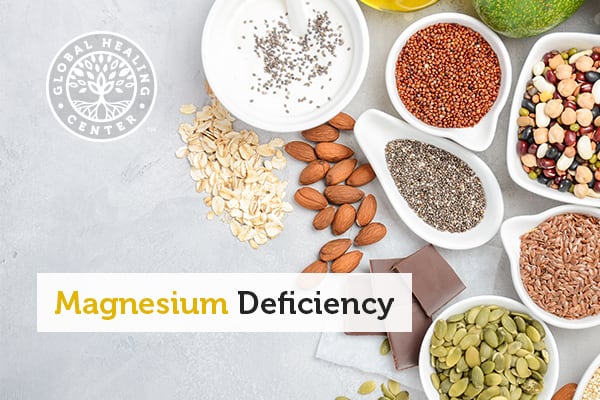
Most people can get enough magnesium from eating a healthy, balanced diet. That means what you might expect — lots of vegetables, beans, fruits, and nuts and seeds — along with some foods you may not have considered, such as dark chocolate. Here are some of the best plant-based foods for magnesium:
Green, Leafy Vegetables
To get the most bang for your buck, go for dark, leafy vegetables, such as kale, spinach, and collard greens. Leafy vegetables are among the most magnesium-rich foods available, and they provide other nutritional benefits. Make them a regular part of your diet.
Nuts & Seeds
Many nuts and seeds are also high in magnesium. If you like to snack on almonds or peanuts, you’re in luck. Chia seeds, pumpkin seeds, and flaxseed can also add magnesium to your diet. If you do not like eating nuts as snacks, try adding them as a topping to non-dairy yogurt or blend them into a smoothie.
Avocados
Add magnesium to the long list of nutrients in our favorite superfood — the avocado. The brain- and heart-healthy avocado is a nutritional powerhouse that provides magnesium and potassium.
Bananas
Bananas are not only a great source of magnesium, but also potassium. Bananas can satisfy your sweet tooth while also providing you with your daily fill of magnesium, as well as vitamin C and fiber.
Figs
Packed with magnesium and other crucial minerals, figs are an often overlooked source of nutrients. Dried figs are a great snack.
Dark Chocolate
Great news for dessert lovers: dark chocolate contains a significant amount of magnesium. That said, most sources of chocolate are high in sugar. Eat chocolate in moderation or add unsweetened cocoa powder to recipes or fresh fruit smoothies.
Whole Grains & Pseudograins
Many whole grains have high magnesium levels. The pseudograins buckwheat and quinoa not only have more magnesium, but they are also higher in protein and antioxidants than traditional grains like wheat, corn, and rice. As a bonus, buckwheat and quinoa are also gluten-free. If you haven’t given them a try, do it!
How Much Magnesium Do You Need?
The RDA for magnesium varies by age. The average healthy adult male in his 20s needs approximately 400 mg of magnesium per day. The requirement for a woman of the same age is a bit lower at 320 mg. Pregnant women should increase their daily allotment to 350 mg.
The table below lists the current RDA for children and adults in the United States as established by the Food and Nutrition Board at the Institute of Medicine of the National Academies.[2] For children under 12 months, the chart lists adequate intake for non-breastfed babies.
If you have health considerations specific to you, talk to your healthcare provider about what serving size is best.
Age
Male
Female
Pregnancy
Lactation
Birth to 6 months
30 mg*
30 mg*
7–12 months
75 mg*
75 mg*
1–3 years
80 mg
80 mg
4–8 years
130 mg
130 mg
9–13 years
240 mg
240 mg
14–18 years
410 mg
360 mg
400 mg
360 mg
19–30 years
400 mg
310 mg
350 mg
310 mg
31–50 years
420 mg
320 mg
360 mg
320 mg
51+ years
420 mg
320 mg
*Adequate Intake
The Best Supplements for Magnesium Deficiency
If you’re concerned that you aren’t getting enough magnesium in your diet, consider supplementation. There are a variety of magnesium supplements available. How well they work depends on the amount of the mineral they contain, how well it dissolves, how well the gut absorbs it, and its bioavailability. Bioavailability is the proportion of a substance the body can use in its biochemical reactions.[12]
Magnesium can be absorbed through the skin, such as by soaking in a bath with Epsom salts. However, other than food, the most common way to get magnesium is through supplements. Options include magnesium orotate, magnesium chloride, or multipurpose supplements which combine magnesium with nutrients that help absorption, such as calcium, vitamin D, and vitamin K.
Magnesium orotate is one of the best choices for supplementation, as it’s the most absorbable form of the mineral. IntraCal™ contains an ideal ratio of calcium to magnesium orotate.
See more about Magnesium Medicine
Points to Remember
Getting adequate magnesium is crucial to achieving optimal health, yet more than 75 percent of people do not get enough of this macromineral. Magnesium plays a role in brain and nervous system health, metabolism, cardiovascular health, and more. Not getting enough magnesium can contribute to a host of health woes, including anxiety, sleep disorders, weight gain, and asthma. You can get magnesium from foods like chocolate, bananas, avocados, and figs, or through supplements.
The amount of magnesium the body needs varies by age. Some situations, such as pregnancy, require more magnesium. A deficiency arises when the body doesn’t get enough magnesium, or can’t use what it does get. A normal blood serum level is 0.75 to 0.95 mmol/L, while less than 0.75 is low.
Have you ever had a magnesium deficiency? Do you take magnesium supplements or try to get enough in your diet? We want to hear your story! Leave a comment below.
References (12)
Magnesium: Fact Sheet for Health Professionals. National Institutes of Health Office of Dietary Supplements. U.S. Department of Health and Human Services. Updated 28 Sep. 2018. Accessed 31 Jul. 2018.
Dr Eddy Bettermann MD focus on Biological Medicine (Biologische Medizin) #Biological #Medicine #videos http://bit.ly/2LF3Ro3, Darkfield Microscopy (Dunkelfeld Mikroskopie), Orthomolecular Medicine (Orthomolekulare Medizin), Ayurvedic Medicine (Ayurveda), Psychosomatic Medicine (Psychosomatische Medizin), raw food (Rohkost), fasting (Fasten):
Our primary integrative medicine goal is the maintenance of your health and wellness, and we are committed to safe and effective healthcare.
Our specialties include online integrative medicine education by alternative doctor: food and allergy management through the use of Integrative medical therapy, Environmental Medicine, General Family Medicine, Ayurveda, Panchakarma, Chronic Fatigue, ADHD, autism, Fibromyalgia, Yeast/Fungus related diseases – Candidacies, mercury dental replacement and detoxification, Natural Thyroid Replacement, Weight loss, Lyme Disease, Irritable Bowel Disease, Attention Deficit Disorder, Pervasive Developmental Disorders, Multiple Chemical Sensitivities, Addiction related programs, Intestinal Dysbiosis, as well as trigger point therapy using Neural Therapy.
Dr. Eddy Bettermann MD, physician from Germany, consultant and teacher in biological medicine, especially dark field microscopy known as Live Blood Analysis in Thailand, Malaysia, Hong Kong, Singapore and the Philippines. But he lecture also in the USA, Canada and the U.A.E. He speaks english and german.
https://dreddymd.com/2017/01/17/the-interactive-live-blood-cd-and-the-certified-training-live-blood-analysis-online-course/
https://dreddymd.com/courses/
https://dreddymd.com/2017/01/17/live-blood-microscopy-analysis-darkfield-course/
“Let thy Food be thy Medicine and thy Medicine be thy Food.” — Hippocrates
Physician Member of the Medical Board at AOX Singapore,
Medical Doctor at Nurse Mobile Clinic and
Physician at DrEddy Clinic
Our Mission:
The mission of the Integrative Medicine is to search for the most effective treatments for patients by combining both conventional and alternative approaches that address all aspects of health and wellness – biological, psychological, social and spiritual. Biological Medicine is a big part of my work and so is Dark field Microscopy, what I use in my daily practice and what I teach more then 15 years in Asia and around the world: Live Blood Analysis in dark field based on Haematology.
We utilize Live blood analysis since 2004, conventional as well as specialty laboratories for a thorough diagnostic work up of the disease in question. Our integrative medicine treatment regimens are especially unique and are tailored specifically to the individual needs of each patient.
Our Mission: don’t harm, prevent, use food as medicine
We are a reliable partner for integrative medicine in Medical Spa & Clinic Development and integrative medicine Education Training for alternative doctors – we bring different holistic approaches, like Integrative Medicine, Traditional Chinese Medicine and Ayurveda Medicine together. On your request we offer our service in your place as well.
Heavy metal poisoning
Heavy metal poisoning is much more common than most people realize, and if you’re thinking that it doesn’t apply to you because you haven’t been exposed to any, think again. If you’ve eaten fish regularly, had amalgam fillings, received vaccinations, drank contaminated water, or done industrial or agricultural work or pharmaceutical manufacturing, there’s a good chance that you have a fair amount of toxic metals in your system..
We are here to help and to educate!
Wishing your health and happiness
Dr Eddy Bettermann MD
We are affiliated The Wellness Company https://bit.ly/3V726zc
The Wellness Company Coupon for membership, supplements, doctor appointment, online consultation https://bit.ly/3V5NsIy
DrEddyClinic is affiliate of Amazon and get commission for the products, which we recommend https://www.amazon.com/shop/dreddyclinic , same as GlobalHealing https://dreddymd.com/shop/supplements/
View all posts by dreddymd

 Most health-conscious people have heard of magnesium (Mg), but many of them don’t know a whole lot about it. Compared to other vitamins and minerals, it tends to fly under the radar. But, it’s a vital nutrient that’s essential for good health.
You may remember magnesium from the periodic table of scientific elements that was posted in your middle school science classroom. It plays a critical role in metabolism, and the body uses it for more than 300 biochemical reactions. Those processes support your immune system, promote a healthy nervous system and brain, maintain cardiovascular health, and build strong muscles and bones.
So, it’s no surprise that when you do not get enough of this macromineral, your health can be negatively affected.[1]
Most health-conscious people have heard of magnesium (Mg), but many of them don’t know a whole lot about it. Compared to other vitamins and minerals, it tends to fly under the radar. But, it’s a vital nutrient that’s essential for good health.
You may remember magnesium from the periodic table of scientific elements that was posted in your middle school science classroom. It plays a critical role in metabolism, and the body uses it for more than 300 biochemical reactions. Those processes support your immune system, promote a healthy nervous system and brain, maintain cardiovascular health, and build strong muscles and bones.
So, it’s no surprise that when you do not get enough of this macromineral, your health can be negatively affected.[1]
 Add magnesium to the long list of nutrients in our favorite superfood — the avocado. The brain- and heart-healthy avocado is a nutritional powerhouse that provides magnesium and potassium.

 If you’re concerned that you aren’t getting enough magnesium in your diet, consider supplementation. There are a variety of magnesium supplements available. How well they work depends on the amount of the mineral they contain, how well it dissolves, how well the gut absorbs it, and its bioavailability. Bioavailability is the proportion of a substance the body can use in its biochemical reactions.[12]
Magnesium can be absorbed through the skin, such as by soaking in a bath with Epsom salts. However, other than food, the most common way to get magnesium is through supplements. Options include magnesium orotate, magnesium chloride, or multipurpose supplements which combine magnesium with nutrients that help absorption, such as calcium, vitamin D, and vitamin K.
Magnesium orotate is one of the best choices for supplementation, as it’s the most absorbable form of the mineral. IntraCal™ contains an ideal ratio of calcium to magnesium orotate.
See more about Magnesium Medicine
If you’re concerned that you aren’t getting enough magnesium in your diet, consider supplementation. There are a variety of magnesium supplements available. How well they work depends on the amount of the mineral they contain, how well it dissolves, how well the gut absorbs it, and its bioavailability. Bioavailability is the proportion of a substance the body can use in its biochemical reactions.[12]
Magnesium can be absorbed through the skin, such as by soaking in a bath with Epsom salts. However, other than food, the most common way to get magnesium is through supplements. Options include magnesium orotate, magnesium chloride, or multipurpose supplements which combine magnesium with nutrients that help absorption, such as calcium, vitamin D, and vitamin K.
Magnesium orotate is one of the best choices for supplementation, as it’s the most absorbable form of the mineral. IntraCal™ contains an ideal ratio of calcium to magnesium orotate.
See more about Magnesium Medicine



 Dr. Eddy Bettermann MD